Abstract reasoning is one of four sections in the HAST exam, which is the transfer test used by 12 selective high schools in NSW for students applying to enter in Years 8 to 11. The exam is created and assessed by ACER.
The abstract reasoning section is 30 minutes long and contains 30 questions. That is one minute per question. Significantly less time than students experience in thinking skills for the Year 6 Selective exam. Time pressure is one of the main reasons students struggle in this section even when they understand the question types.
There are three types of questions that appear in the abstract reasoning section of the HAST exam:
- Complete the pattern
- Middle of sequence
- Next in sequence
Not all three types will necessarily appear in every sitting, but all three should be understood and practised before the exam. This guide covers what each type involves, what to look for, and how to approach them.
Why abstract reasoning is different from other exam sections
"The question types are consistent and learnable. A student who has practised all three types thoroughly will approach the exam with a clear framework for each one."
Most exam sections test knowledge or skills that students have built up through school. Reading comprehension, mathematics, writing: these all draw on what students have been taught.
Abstract reasoning does not. There is no subject in the school curriculum that directly prepares students for this section. Students who have strong mathematical foundations tend to find it easier because they are already comfortable identifying patterns, but the question format itself is unfamiliar to most students until they specifically prepare for it.
This is one of the main reasons parents seek tutoring for abstract reasoning specifically. A student who has never seen these question types before and encounters them for the first time in the actual exam, under time pressure in an unfamiliar environment, is at a significant disadvantage. The good news is that the question types are consistent and learnable. A student who has practised all three types thoroughly will approach the exam with a clear framework for each one.
It is also worth noting why ACER uses abstract reasoning in the HAST rather than a language-based reasoning section. Because two of the four HAST sections (reading comprehension and writing) are already language-dependent, abstract reasoning provides a more equitable way to assess logical thinking for students who may not have been learning in English for long. The patterns and diagrams require no English language knowledge to interpret.
The exam format
Multiple choice, four options. Questions increase in difficulty through the section.
Students in Years 7 and 8 applying for Years 8 and 9 entry will see more straightforward versions of each question type. Students in Years 9 and 10 applying for Years 10 and 11 entry will encounter more variables and more complex patterns.
Complete the pattern
A grid of shapes, usually a 3x3 arrangement, is presented with one cell missing, marked with a question mark. Students must identify which of four options correctly completes the pattern.
The shapes in each cell follow a rule across the grid. That rule may involve one variable or several. Common variables include:
- The shading of each shape or section within a shape
- The orientation of a shape (rotated, flipped, reflected)
- The size of shapes
- The number of shapes in each cell
- The position of a smaller shape relative to a larger one
The difficulty of complete the pattern questions comes from the number of variables being tracked simultaneously. In a simpler question, the pattern may follow one clear rule. In a harder question, multiple elements may be changing at once, each following its own rule, and the correct answer is the only option that satisfies all of them simultaneously.
How to approach it
Look at each row and each column separately. Identify what changes from cell to cell. Try to find a rule that consistently explains every cell in the grid. Once you have a rule, test it against the four answer options. The correct answer is the one that completes every rule without exception.
Do not spend more than a minute on any single question. If the rule is not clear after a quick scan, make an educated guess and move on. Coming back to it is rarely possible given the time constraint.
Example:
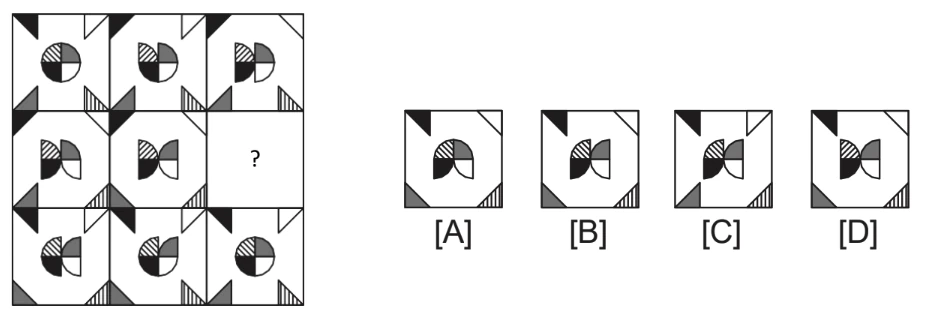
Complete the pattern: example question. The correct answer is B.
In this example, the grid has 9 cells, and in each succeeding cell, read from left to right across a row and then continuing left to right on the next row, two elements move: one shaded quadrant inside a circle and one triangle in a corner. Both elements follow the same clockwise sequence, moving from the upper-left position to the upper-right, then the bottom-right, and finally the bottom-left. To find the missing cell in the middle-right position, the next clockwise position for both the shaded quadrant and the triangle must be applied simultaneously. Option B satisfies both rules.
Middle of sequence
Five items are presented, all showing variations of the same pattern. The five items can be arranged into a logical sequence from one extreme to another. Students must identify which item belongs in the middle, position 3 of 5, when the items are arranged in the correct order.
Because students need to identify a middle position, there are five answer options (A, B, C, D, E) rather than the usual four.
The sequence typically involves a gradual change across a single variable or multiple variables: a shape rotating incrementally, a line changing angle, a dot moving position, or the number of elements increasing or decreasing step by step.
How to approach it
First identify what is changing across the five items. Then try to arrange them in the order that shows the most gradual, consistent progression. The item in the middle of that arrangement is the answer.
A useful shortcut is to identify the two clear extremes first: the item that represents one end of the sequence and the item that represents the other. The middle item should be roughly halfway between those two.
Example:
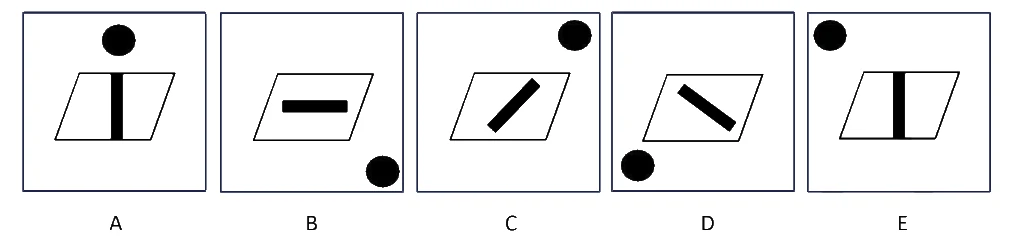
Middle of sequence: example question. The correct answer is B.
In this example, five boxes each contain a parallelogram with a line inside it and a dot. Two things change across the five items: the angle of the line inside the parallelogram, and the position of the dot, which moves clockwise or anticlockwise around the figure. The correct order is A → C → B → D → E (or its reverse), which places B in the middle position.
Next in sequence
Four items are presented in a sequence from left to right, connected by arrows. Students must identify the rule for the sequence and choose from A, B, C or D the one that most logically and simply comes next.
This is the most common question type in the abstract reasoning section. Unlike middle of sequence, where students must find a position within a set, next in sequence requires students to extend the pattern one step further.
The pattern may involve:
- A shape rotating by a fixed number of degrees with each step
- An element moving position clockwise or anticlockwise
- Alternating between two states
- A consistent transformation being applied at each step
How to approach it
Identify the rule that connects each item to the next. Confirm the rule works for all four visible items. Then apply that rule one more time to determine what comes fifth.
Hypothesise, test, confirm. Do not try to find the answer by elimination alone. Always identify the underlying rule first. Students who jump straight to comparing answer options without finding the rule first tend to be misled by options designed to look plausible.
Example:
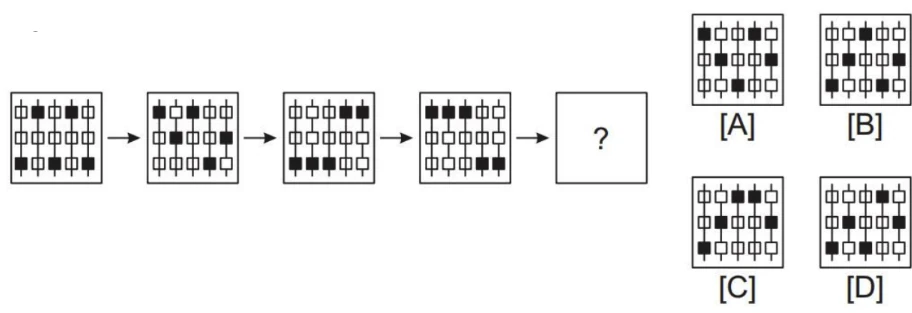
Next in sequence: example question. The correct answer is D.
In this example, each frame shows a grid of small squares, each containing a smaller inner square that is either black or white. The rule involves multiple rows: the black squares on the 1st, 3rd, and 4th rows swap with the white square on the opposite end of the row, while the black square on the 2nd row moves one square downward and the black square on the 5th row moves one square upward. Applying this rule to the fourth frame gives option D.
Preparing for abstract reasoning
"One minute per question is tight. In harder questions with multiple variables, a student who has not developed a systematic approach will spend too long on one question and run out of time before the end of the section."
The most important thing to understand about preparing for abstract reasoning is that familiarity with the question types is the starting point, not the end point.
A student who has seen each question type once will recognise them in the exam. A student who has practised each type dozens of times under timed conditions will be able to identify the rule quickly and move on without spending precious seconds orienting themselves.
One minute per question is tight. In harder questions with multiple variables, a student who has not developed a systematic approach will spend too long on one question and run out of time before the end of the section. The habit of working methodically: identify the variable, test the rule, confirm, select. It needs to be automatic before exam day.
A note on practice materials: many online abstract reasoning resources are designed for psychometric testing in adult job applications, or for the Year 6 Selective exam which is set by a different provider. These can be useful for building general pattern recognition, but they are not necessarily aligned with the specific question formats and difficulty levels of the HAST exam. Students who have done the HAST exam consistently report that generic practice tests do not reflect the actual exam closely. Working with a tutor who has experience specifically with HAST preparation gives students access to more relevant materials and direct feedback on the specific areas where they are losing marks.
The difficulty of questions in the section also scales with the year level. Questions written for Year 8 entry are meaningfully easier than questions written for Year 11 entry. Students should ensure the practice materials they are using match the year level they are applying for.
Try it yourself
The best way to understand how these question types feel under time pressure is to attempt them. The three questions below are one example from each type covered in this guide. Select your answer to see the explanation of the rule.
Preparing with Bing's Academy
John sat the HAST exam three times, in Years 8, 9 and 10, before successfully transferring to Girraween High School for Year 11 entry. Abstract reasoning was a key part of his preparation each time.
At Bing's Academy, we work with students on all three abstract reasoning question types with materials that reflect the actual HAST exam format and difficulty. Every student starts with an assessment so we know which question types are already comfortable and which need the most work.
If you are preparing for the HAST exam and want to understand what abstract reasoning preparation should look like, get in touch. We can help you understand where your child currently sits and what a realistic preparation timeline looks like.
For more on the HAST exam overall, including how the application process works and what supporting documentation schools require, see our HAST transfer guide.

John 'Bing' Huang
Founder, Bing's Academy